 TypeShade
Hillshade
Shaded relief.
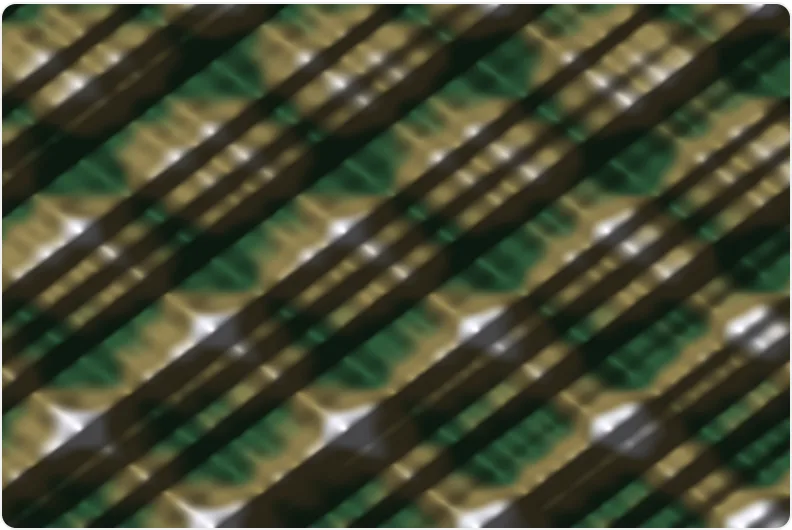
// ═══ typeshade example — hillshade (shaded relief) ═══//// A cartographic shader: procedural terrain + Lambert hillshade, the shaded-relief look// of a topographic map. A reusable `terrain()` DSL function (called 3× — once for height,// twice for a finite-difference normal) feeds a sun-lit hypsometric tint. The sun azimuth// and vertical exaggeration are live uniforms; the terrain drifts over time.
import {  fn,  module,  vec2,  vec3,  vec4,  sin,  cos,  radians,  clamp,  dot,  length,  mix,  smoothstep,  f32,  f32T,  vec2fT,} from '../src/index.js';import { VsOut, vs, fullscreenUniforms } from './_fullscreen.js';import type { Node } from '../src/index.js';import type { ShaderExample } from './_shared.js';const U = fullscreenUniforms({ sun_az: f32T, exaggeration: f32T });
// normalize() isn't a DSL builtin — it's just v · (1/|v|). The author spells it inline.const normalize3 = (v: Node<'vec3<f32>'>): Node<'vec3<f32>'> => v.mul(f32(1).div(length(v)));
// Reusable terrain height field, ~[0,1]. Emitted once, called 3× — a real DSL function.const terrain = fn('terrain', { p: vec2fT, t: f32T }, ({ p, t }) => {  const h = sin(p.x.mul(3).add(t))    .mul(cos(p.y.mul(3)))    .add(      sin(p.x.mul(6.1).sub(t.mul(0.7)))        .mul(cos(p.y.mul(5.3)))        .mul(0.5),    )    .add(      sin(p.x.mul(12.7))        .mul(cos(p.y.mul(11.1)))        .mul(0.25),    );  return h.mul(0.28).add(0.5);});
const fs = fn(  'fs',  { vo: VsOut },  ({ vo }) => {    const uv = vo.uv;    const t = U.field.time;    const az = radians(U.field.sun_az);    const ex = U.field.exaggeration;    const p = uv.mul(6);    const eps = f32(0.015);
    // Height + two neighbours → a finite-difference surface normal.    const h = terrain({ p, t });    const hx = terrain({ p: vec2(p.x.add(eps), p.y), t });    const hy = terrain({ p: vec2(p.x, p.y.add(eps)), t });    const n = normalize3(vec3(h.sub(hx).mul(ex), h.sub(hy).mul(ex), eps));
    // Sun from the azimuth (fixed elevation) → Lambert term.    const sun = normalize3(vec3(cos(az).mul(0.6), sin(az).mul(0.6), 0.55));    const shade = clamp(dot(n, sun), 0, 1);
    // Hypsometric tint: lowland green → upland tan → snow.    const low = vec3(0.16, 0.32, 0.2);    const mid = vec3(0.55, 0.49, 0.3);    const high = vec3(0.93, 0.93, 0.96);    const base = mix(mix(low, mid, smoothstep(0.3, 0.55, h)), high, smoothstep(0.62, 0.85, h));    const lit = base.mul(shade.mul(0.8).add(0.3));    return vec4(lit, 1);  },  { stage: 'fragment', retAttr: '@location(0)' },);
// `terrain` is called via its handle in `fs`, so module() collects it transitively — funcs lists only the entry points.const hillshadeModule = module({  structs: [U.struct, VsOut.decl],  bindings: [U.binding],  funcs: [vs, fs],});
export const hillshade: ShaderExample = {  id: 'hillshade',  title: 'Hillshade',  blurb:    'Shaded relief — procedural terrain lit by a movable sun, tinted hypsometrically. A reusable terrain() DSL function is called 3× for the height + finite-difference normal.',  category: 'cartographic',  file: 'hillshade.ts',  module: hillshadeModule,  renderable: true,  controls: {    time: { kind: 'time' },    resolution: { kind: 'resolution' },    sun_az: { kind: 'slider', label: 'Sun azimuth (°)', min: 0, max: 360, step: 1, value: 135 },    exaggeration: {      kind: 'slider',      label: 'Exaggeration',      min: 0.5,      max: 6,      step: 0.1,      value: 2.5,    },  },};
struct Uniforms { time: f32, resolution: vec2<f32>, sun_az: f32, exaggeration: f32,}
struct VsOut { @builtin(position) pos: vec4<f32>, @location(0) uv: vec2<f32>,}
@group(0) @binding(0) var<uniform> U: Uniforms;
fn terrain(p: vec2<f32>, t: f32) -> f32 { return (((((sin(((p.x * 3.0) + t)) * cos((p.y * 3.0))) + ((sin(((p.x * 6.1) - (t * 0.7))) * cos((p.y * 5.3))) * 0.5)) + ((sin((p.x * 12.7)) * cos((p.y * 11.1))) * 0.25)) * 0.28) + 0.5);}
@vertexfn vs(@builtin(vertex_index) vi: u32) -> VsOut { let _cse0 = ((f32((vi & 1u)) * 4.0) - 1.0); let _cse1 = ((f32((vi >> 1u)) * 4.0) - 1.0); return VsOut(vec4<f32>(_cse0, _cse1, 0.0, 1.0), vec2<f32>(((_cse0 * 0.5) + 0.5), ((_cse1 * 0.5) + 0.5)));}
@fragmentfn fs(vo: VsOut) -> @location(0) vec4<f32> { let _cse6 = (vo.uv * 6.0); let _cse2 = terrain(_cse6, U.time); let _cse3 = _cse6.x; let _cse4 = _cse6.y; let _cse0 = vec3<f32>(((_cse2 - terrain(vec2<f32>((_cse3 + 0.015), _cse4), U.time)) * U.exaggeration), ((_cse2 - terrain(vec2<f32>(_cse3, (_cse4 + 0.015)), U.time)) * U.exaggeration), 0.015); let _cse5 = radians(U.sun_az); let _cse1 = vec3<f32>((cos(_cse5) * 0.6), (sin(_cse5) * 0.6), 0.55); return vec4<f32>((mix(mix(vec3<f32>(0.16, 0.32, 0.2), vec3<f32>(0.55, 0.49, 0.3), smoothstep(0.3, 0.55, _cse2)), vec3<f32>(0.93, 0.93, 0.96), smoothstep(0.62, 0.85, _cse2)) * ((clamp(dot((_cse0 * (1.0 / length(_cse0))), (_cse1 * (1.0 / length(_cse1)))), 0.0, 1.0) * 0.8) + 0.3)), 1.0);}#version 300 esprecision highp float;precision highp int;
out vec2 uv;
void main() { uint vi = uint(gl_VertexID); float _cse0 = ((float((vi & 1u)) * 4.0) - 1.0); float _cse1 = ((float((vi >> 1u)) * 4.0) - 1.0); gl_Position = vec4(_cse0, _cse1, 0.0, 1.0); uv = vec2(((_cse0 * 0.5) + 0.5), ((_cse1 * 0.5) + 0.5));}#version 300 esprecision highp float;precision highp int;
layout(std140) uniform Uniforms { float time; vec2 resolution; float sun_az; float exaggeration;} U;float terrain(vec2 p, float t) { return (((((sin(((p.x * 3.0) + t)) * cos((p.y * 3.0))) + ((sin(((p.x * 6.1) - (t * 0.7))) * cos((p.y * 5.3))) * 0.5)) + ((sin((p.x * 12.7)) * cos((p.y * 11.1))) * 0.25)) * 0.28) + 0.5);}in vec2 uv;layout(location = 0) out vec4 _ret;
void main() { vec2 _cse6 = (uv * 6.0); float _cse2 = terrain(_cse6, U.time); float _cse3 = _cse6.x; float _cse4 = _cse6.y; vec3 _cse0 = vec3(((_cse2 - terrain(vec2((_cse3 + 0.015), _cse4), U.time)) * U.exaggeration), ((_cse2 - terrain(vec2(_cse3, (_cse4 + 0.015)), U.time)) * U.exaggeration), 0.015); float _cse5 = radians(U.sun_az); vec3 _cse1 = vec3((cos(_cse5) * 0.6), (sin(_cse5) * 0.6), 0.55); _ret = vec4((mix(mix(vec3(0.16, 0.32, 0.2), vec3(0.55, 0.49, 0.3), smoothstep(0.3, 0.55, _cse2)), vec3(0.93, 0.93, 0.96), smoothstep(0.62, 0.85, _cse2)) * ((clamp(dot((_cse0 * (1.0 / length(_cse0))), (_cse1 * (1.0 / length(_cse1)))), 0.0, 1.0) * 0.8) + 0.3)), 1.0);}Hillshade, drawn at build time.
The WGSL and GLSL tabs are the compiler's own output at commit 26de7be8, read from the goldens its emit suite bakes (emit-goldens.test.ts).
This example is written against the fn() builder API, which the editor in the Playground does not take.