 TypeShade
Voronoi
Animated cellular noise.
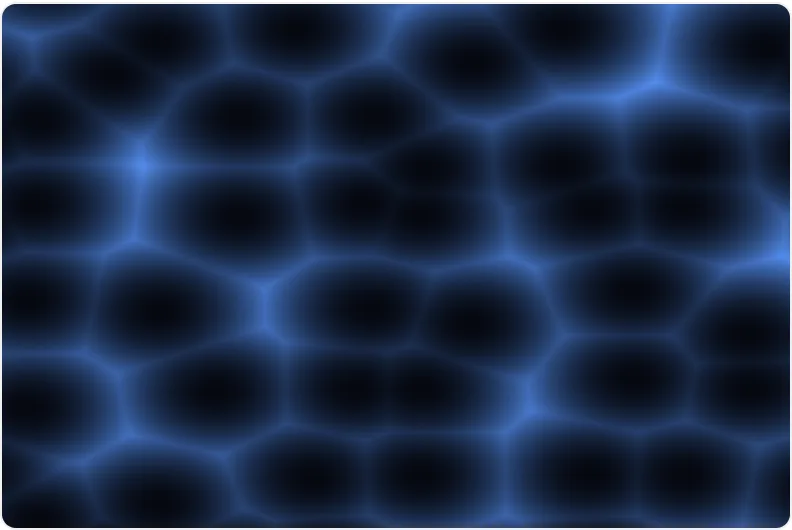
// ═══ typeshade example — animated Voronoi (cellular noise) ═══//// The classic ShaderToy cellular pattern: tile the plane into cells, scatter one// animated feature point per cell, and shade each fragment by the DISTANCE to its// nearest point (a 3×3 neighbour scan). Showcases the `distance` builtin + the DSL's// nested `Loop`. One source → WGSL (WebGPU) + GLSL ES 3.00 (WebGL2) + Reflection.
import {  fn,  module,  i32,  f32,  toF32,  vec2,  vec3,  vec4,  sin,  cos,  floor,  fract,  dot,  min,  distance,  Loop,  Let,  f32T,  vec2fT,} from '../src/index.js';import { VsOut, vs, fullscreenUniforms } from './_fullscreen.js';import type { ShaderExample } from './_shared.js';const U = fullscreenUniforms({ cells: f32T });
// Hash a cell coordinate → a stable point in [0,1]² (the per-cell feature seed).const hash2 = fn('hash2', { c: vec2fT }, ({ c }) => {  const h = vec2(dot(c, vec2(127.1, 311.7)), dot(c, vec2(269.5, 183.3)));  return fract(vec2(sin(h.x), sin(h.y)).mul(43758.5453));});
const fs = fn(  'fs',  { vo: VsOut },  ({ vo }) => {    const uv = vo.uv;    const p = uv.mul(U.field.cells);    const cell = floor(p);    const f = fract(p);    const md = f32(8); // nearest-point distance accumulator    // 3×3 neighbour scan — the nearest feature point may live in an adjacent cell.    Loop(      i32(-1),      (j) => j.le(1),      (j) => {        Loop(          i32(-1),          (i) => i.le(1),          (i) => {            const g = Let(vec2(toF32(i), toF32(j)));            const seed = Let(hash2({ c: cell.add(g) })); // materialise once: the loop counters are mutated `var`s, so CSE can't hoist the hash — without Let the 3 `seed.*` reads re-call hash2() per iteration            // animate each point on a small orbit around its cell so the pattern shimmers            const pt = g              .add(seed.mul(0.5).add(0.25))              .add(                vec2(                  sin(U.field.time.add(seed.x.mul(6.283))),                  cos(U.field.time.add(seed.y.mul(6.283))),                ).mul(0.18),              );            md.assign(min(md, distance(f, pt)));          },        );      },    );    // tint the distance field: dark cores, cool cell walls    const c = vec3(md.mul(md))      .mul(vec3(0.35, 0.6, 1.0))      .add(vec3(0.02, 0.03, 0.06));    return vec4(c, 1);  },  { stage: 'fragment', retAttr: '@location(0)' },);
// `hash2` is called via its handle in `fs`, so module() collects it transitively — funcs lists only the entry points.const voronoiModule = module({  structs: [U.struct, VsOut.decl],  bindings: [U.binding],  funcs: [vs, fs],});
export const voronoi: ShaderExample = {  id: 'voronoi',  title: 'Voronoi',  blurb:    'Animated cellular noise — each fragment shaded by the distance to its nearest of a grid of orbiting feature points (a 3×3 neighbour scan). Built on the `distance` builtin + nested loops.',  category: 'generic',  file: 'voronoi.ts',  module: voronoiModule,  renderable: true,  controls: {    time: { kind: 'time' },    resolution: { kind: 'resolution' },    cells: { kind: 'slider', label: 'Cell density', min: 2, max: 16, step: 1, value: 6 },  },};
struct Uniforms { time: f32, resolution: vec2<f32>, cells: f32,}
struct VsOut { @builtin(position) pos: vec4<f32>, @location(0) uv: vec2<f32>,}
@group(0) @binding(0) var<uniform> U: Uniforms;
fn hash2(c: vec2<f32>) -> vec2<f32> { let _cse0 = vec2<f32>(dot(c, vec2<f32>(127.1, 311.7)), dot(c, vec2<f32>(269.5, 183.3))); return fract((vec2<f32>(sin(_cse0.x), sin(_cse0.y)) * 43758.5453));}
@vertexfn vs(@builtin(vertex_index) vi: u32) -> VsOut { let _cse0 = ((f32((vi & 1u)) * 4.0) - 1.0); let _cse1 = ((f32((vi >> 1u)) * 4.0) - 1.0); return VsOut(vec4<f32>(_cse0, _cse1, 0.0, 1.0), vec2<f32>(((_cse0 * 0.5) + 0.5), ((_cse1 * 0.5) + 0.5)));}
@fragmentfn fs(vo: VsOut) -> @location(0) vec4<f32> { let _licm0 = U.time; var _av0: f32 = 8.0; let _cse0 = (vo.uv * U.cells); for (var _v0: i32 = -1; (_v0 <= 1); _v0 = (_v0 + 1)) { for (var _v1: i32 = -1; (_v1 <= 1); _v1 = (_v1 + 1)) { let _v2 = vec2<f32>(f32(_v1), f32(_v0)); let _v3 = hash2((floor(_cse0) + _v2)); _av0 = min(_av0, distance(fract(_cse0), ((_v2 + ((_v3 * 0.5) + 0.25)) + (vec2<f32>(sin((_licm0 + (_v3.x * 6.283))), cos((_licm0 + (_v3.y * 6.283)))) * 0.18)))); } } return vec4<f32>(((vec3<f32>((_av0 * _av0)) * vec3<f32>(0.35, 0.6, 1.0)) + vec3<f32>(0.02, 0.03, 0.06)), 1.0);}#version 300 esprecision highp float;precision highp int;
out vec2 uv;
void main() { uint vi = uint(gl_VertexID); float _cse0 = ((float((vi & 1u)) * 4.0) - 1.0); float _cse1 = ((float((vi >> 1u)) * 4.0) - 1.0); gl_Position = vec4(_cse0, _cse1, 0.0, 1.0); uv = vec2(((_cse0 * 0.5) + 0.5), ((_cse1 * 0.5) + 0.5));}#version 300 esprecision highp float;precision highp int;
layout(std140) uniform Uniforms { float time; vec2 resolution; float cells;} U;vec2 hash2(vec2 c) { vec2 _cse0 = vec2(dot(c, vec2(127.1, 311.7)), dot(c, vec2(269.5, 183.3))); return fract((vec2(sin(_cse0.x), sin(_cse0.y)) * 43758.5453));}in vec2 uv;layout(location = 0) out vec4 _ret;
void main() { float _licm0 = U.time; float _av0 = 8.0; vec2 _cse0 = (uv * U.cells); for (int _v0 = -1; (_v0 <= 1); _v0 = (_v0 + 1)) { for (int _v1 = -1; (_v1 <= 1); _v1 = (_v1 + 1)) { vec2 _v2 = vec2(float(_v1), float(_v0)); vec2 _v3 = hash2((floor(_cse0) + _v2)); _av0 = min(_av0, distance(fract(_cse0), ((_v2 + ((_v3 * 0.5) + 0.25)) + (vec2(sin((_licm0 + (_v3.x * 6.283))), cos((_licm0 + (_v3.y * 6.283)))) * 0.18)))); } } _ret = vec4(((vec3((_av0 * _av0)) * vec3(0.35, 0.6, 1.0)) + vec3(0.02, 0.03, 0.06)), 1.0);}Voronoi, drawn at build time.
The WGSL and GLSL tabs are the compiler's own output at commit 26de7be8, read from the goldens its emit suite bakes (emit-goldens.test.ts).
This example is written against the fn() builder API, which the editor in the Playground does not take.