 TypeShade
Kaleidoscope
The polar mirror fold.
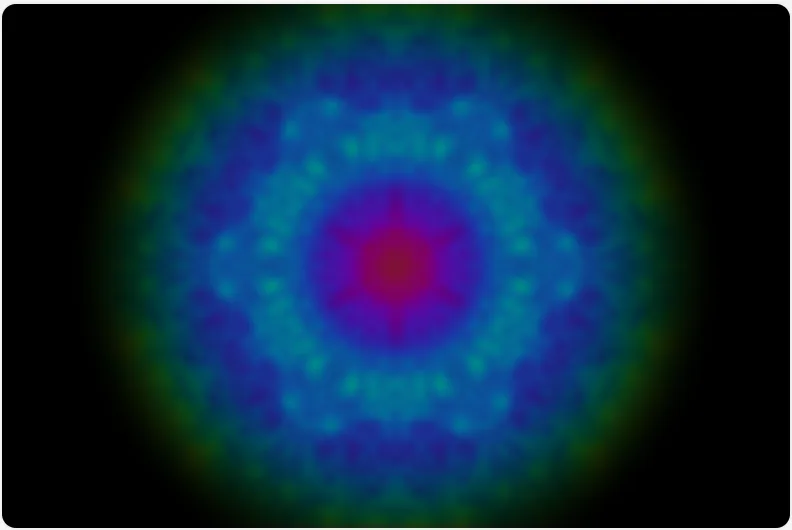
// ═══ typeshade example — kaleidoscope (polar mirror fold) ═══//// The kaleidoscope fold: convert to polar, floor-mod the angle into one// sector, mirror about the sector's midline, convert back — every sector now// shows the same wedge of pattern, seamlessly. The pattern inside the wedge is// swirling fbm + concentric rings through a cosine palette. The fold uses// `mod` (#839), the portable FLOOR-mod, so the negative angles atan2// produces wrap identically on both targets. WGSL + GLSL ES 3.00 (WebGL2).
import {  fn,  module,  f32,  vec2,  vec3,  vec4,  sin,  cos,  floor,  fract,  mix,  abs,  mod,  length,  atan2,  smoothstep,  Let,  f32T,  vec2fT,  u32,  i32,  u32T,} from '../src/index.js';import { VsOut, vs, fullscreenUniforms, screenCoords } from './_fullscreen.js';import type { ShaderExample } from './_shared.js';const U = fullscreenUniforms({ segments: f32T });
// An exact integer hash (lowbias32 with xxHash's primes): every target and the CPU oracle// agree on every bit of it. `fract(sin(x) * 43758.5453)` did not, since WGSL bounds `sin`// only to 2^-11 and the multiply puts that error above the fraction (#184).const hash32 = fn('hash32', { x: u32T }, ({ x }) => {  const a = Let(x.bitXor(x.shr(16)).mul(0x85ebca77));  const b = Let(a.bitXor(a.shr(13)).mul(0xc2b2ae3d));  return b.bitXor(b.shr(16));});
// scalar hash of a lattice point → [0,1): 24 bits, which f32 holds exactlyconst hash = fn('hash', { p: vec2fT }, ({ p }) => {  const h = Let(hash32({ x: u32(i32(p.x)).bitXor(hash32({ x: u32(i32(p.y)) })) }));  return f32(h.shr(8)).mul(5.9604644775390625e-8); // 2^-24, exact: WGSL lets `/` round});
// bilinear value noise with smootherstep weightsconst noise = fn('noise', { p: vec2fT }, ({ p }) => {  const i = Let(floor(p));  const f = Let(fract(p));  const u = f.mul(f).mul(vec2(3).sub(f.mul(2)));  return mix(    mix(hash({ p: i }), hash({ p: i.add(vec2(1, 0)) }), u.x),    mix(hash({ p: i.add(vec2(0, 1)) }), hash({ p: i.add(vec2(1, 1)) }), u.x),    u.y,  );});
// 4-octave fbm, unrolled so the helper stays a pure value expressionconst fbm = fn('fbm', { p: vec2fT }, ({ p }) => {  return noise({ p })    .mul(0.5)    .add(noise({ p: p.mul(2.02) }).mul(0.25))    .add(noise({ p: p.mul(4.08) }).mul(0.125))    .add(noise({ p: p.mul(8.2) }).mul(0.0625));});
const palette = fn('palette', { t: f32T }, ({ t }) => {  const ph = vec3(0.0, 0.33, 0.67);  return vec3(0.5).add(cos(t.add(ph).mul(6.283)).mul(0.5));});
const fs = fn(  'fs',  { vo: VsOut },  ({ vo }) => {    const t = U.field.time;    const res = U.field.resolution;    const p = screenCoords(vo.uv, res);    const r = Let(length(p));    const a0 = Let(atan2(p.y, p.x));    // fold: floor-mod the angle into one sector, mirror about its midline    const sector = Let(f32(6.2831853).div(U.field.segments));    const am = mod(a0, sector);    const af = Let(abs(am.sub(sector.mul(0.5))));    const q = vec2(cos(af), sin(af)).mul(r);    // wedge pattern: swirling fbm + concentric rings    const v = Let(fbm({ p: q.mul(3).add(vec2(t.mul(0.12), t.mul(0.09).neg())) }));    const rings = sin(r.mul(9).sub(t.mul(0.8)))      .mul(0.5)      .add(0.5);    const col = palette({ t: v.mul(0.7).add(rings.mul(0.15)).add(r.mul(0.3)).sub(t.mul(0.03)) });    // the fbm field doubles as a brightness relief so the wedges keep depth    const relief = v.mul(0.9).add(0.35);    // vignette so the fold's outer edge fades instead of clipping    const vig = f32(1).sub(smoothstep(0.55, 1.25, r));    return vec4(col.mul(relief).mul(vig), 1);  },  { stage: 'fragment', retAttr: '@location(0)' },);
const kaleidoscopeModule = module({  structs: [U.struct, VsOut.decl],  bindings: [U.binding],  funcs: [vs, fs],});
export const kaleidoscope: ShaderExample = {  id: 'kaleidoscope',  title: 'Kaleidoscope',  blurb:    'The polar mirror fold — the angle floor-modded into one sector and mirrored about its midline, so every sector repeats the same wedge of swirling fbm and rings. Segment count is live.',  category: 'generic',  file: 'kaleidoscope.ts',  module: kaleidoscopeModule,  renderable: true,  controls: {    time: { kind: 'time' },    resolution: { kind: 'resolution' },    segments: { kind: 'slider', label: 'Segments', min: 3, max: 12, step: 1, value: 6 },  },};
struct Uniforms { time: f32, resolution: vec2<f32>, segments: f32,}
struct VsOut { @builtin(position) pos: vec4<f32>, @location(0) uv: vec2<f32>,}
@group(0) @binding(0) var<uniform> U: Uniforms;
fn hash32(x: u32) -> u32 { let _v0 = ((x ^ (x >> 16u)) * 2246822519u); let _v1 = ((_v0 ^ (_v0 >> 13u)) * 3266489917u); return (_v1 ^ (_v1 >> 16u));}
fn hash(p: vec2<f32>) -> f32 { let _v0 = hash32((u32(i32(p.x)) ^ hash32(u32(i32(p.y))))); return (f32((_v0 >> 8u)) * 5.960464477539063e-8);}
fn noise(p: vec2<f32>) -> f32 { let _v0 = floor(p); let _v1 = fract(p); let _cse0 = vec2<f32>(3.0); let _gv0 = ((_v1 * _v1) * (_cse0 - (_v1 * 2.0))); let _lc0 = _gv0.x; return mix(mix(hash(_v0), hash((_v0 + vec2<f32>(1.0, 0.0))), _lc0), mix(hash((_v0 + vec2<f32>(0.0, 1.0))), hash((_v0 + vec2<f32>(1.0, 1.0))), _lc0), _gv0.y);}
fn fbm(p: vec2<f32>) -> f32 { return ((((noise(p) * 0.5) + (noise((p * 2.02)) * 0.25)) + (noise((p * 4.08)) * 0.125)) + (noise((p * 8.2)) * 0.0625));}
fn palette(t: f32) -> vec3<f32> { return (vec3<f32>(0.5) + (cos(((t + vec3<f32>(0.0, 0.33, 0.67)) * 6.283)) * 0.5));}
@vertexfn vs(@builtin(vertex_index) vi: u32) -> VsOut { let _cse0 = ((f32((vi & 1u)) * 4.0) - 1.0); let _cse1 = ((f32((vi >> 1u)) * 4.0) - 1.0); return VsOut(vec4<f32>(_cse0, _cse1, 0.0, 1.0), vec2<f32>(((_cse0 * 0.5) + 0.5), ((_cse1 * 0.5) + 0.5)));}
@fragmentfn fs(vo: VsOut) -> @location(0) vec4<f32> { let _cse0 = vec2<f32>((((vo.uv.x * 2.0) - 1.0) * (U.resolution.x / U.resolution.y)), ((vo.uv.y * 2.0) - 1.0)); let _v0 = length(_cse0); let _v1 = atan2(_cse0.y, _cse0.x); let _v2 = (6.2831853 / U.segments); let _v3 = abs(((_v1 - _v2 * floor(_v1 / _v2)) - (_v2 * 0.5))); let _v4 = fbm((((vec2<f32>(cos(_v3), sin(_v3)) * _v0) * 3.0) + vec2<f32>((U.time * 0.12), (-(U.time * 0.09))))); return vec4<f32>(((palette(((((_v4 * 0.7) + (((sin(((_v0 * 9.0) - (U.time * 0.8))) * 0.5) + 0.5) * 0.15)) + (_v0 * 0.3)) - (U.time * 0.03))) * ((_v4 * 0.9) + 0.35)) * (1.0 - smoothstep(0.55, 1.25, _v0))), 1.0);}#version 300 esprecision highp float;precision highp int;
out vec2 uv;
void main() { uint vi = uint(gl_VertexID); float _cse0 = ((float((vi & 1u)) * 4.0) - 1.0); float _cse1 = ((float((vi >> 1u)) * 4.0) - 1.0); gl_Position = vec4(_cse0, _cse1, 0.0, 1.0); uv = vec2(((_cse0 * 0.5) + 0.5), ((_cse1 * 0.5) + 0.5));}#version 300 esprecision highp float;precision highp int;
layout(std140) uniform Uniforms { float time; vec2 resolution; float segments;} U;int _f2i(float x) { return int(mix(clamp(x, -2147483648.0, 2147483520.0), 0.0, isnan(x)));}uint hash32(uint x) { uint _v0 = ((x ^ (x >> 16u)) * 2246822519u); uint _v1 = ((_v0 ^ (_v0 >> 13u)) * 3266489917u); return (_v1 ^ (_v1 >> 16u));}
float hash(vec2 p) { uint _v0 = hash32((uint(_f2i(p.x)) ^ hash32(uint(_f2i(p.y))))); return (float((_v0 >> 8u)) * 5.960464477539063e-8);}
float noise(vec2 p) { vec2 _v0 = floor(p); vec2 _v1 = fract(p); vec2 _cse0 = vec2(3.0); vec2 _gv0 = ((_v1 * _v1) * (_cse0 - (_v1 * 2.0))); float _lc0 = _gv0.x; return mix(mix(hash(_v0), hash((_v0 + vec2(1.0, 0.0))), _lc0), mix(hash((_v0 + vec2(0.0, 1.0))), hash((_v0 + vec2(1.0, 1.0))), _lc0), _gv0.y);}
float fbm(vec2 p) { return ((((noise(p) * 0.5) + (noise((p * 2.02)) * 0.25)) + (noise((p * 4.08)) * 0.125)) + (noise((p * 8.2)) * 0.0625));}
vec3 palette(float t) { return (vec3(0.5) + (cos(((t + vec3(0.0, 0.33, 0.67)) * 6.283)) * 0.5));}in vec2 uv;layout(location = 0) out vec4 _ret;
void main() { vec2 _cse0 = vec2((((uv.x * 2.0) - 1.0) * (U.resolution.x / U.resolution.y)), ((uv.y * 2.0) - 1.0)); float _v0 = length(_cse0); float _v1 = atan(_cse0.y, _cse0.x); float _v2 = (6.2831853 / U.segments); float _v3 = abs((mod(_v1, _v2) - (_v2 * 0.5))); float _v4 = fbm((((vec2(cos(_v3), sin(_v3)) * _v0) * 3.0) + vec2((U.time * 0.12), (-(U.time * 0.09))))); _ret = vec4(((palette(((((_v4 * 0.7) + (((sin(((_v0 * 9.0) - (U.time * 0.8))) * 0.5) + 0.5) * 0.15)) + (_v0 * 0.3)) - (U.time * 0.03))) * ((_v4 * 0.9) + 0.35)) * (1.0 - smoothstep(0.55, 1.25, _v0))), 1.0);}Kaleidoscope, drawn at build time.
The WGSL and GLSL tabs are the compiler's own output at commit 26de7be8, read from the goldens its emit suite bakes (emit-goldens.test.ts).
This example is written against the fn() builder API, which the editor in the Playground does not take.