 TypeShade
Truchet tiles
타일 하나.
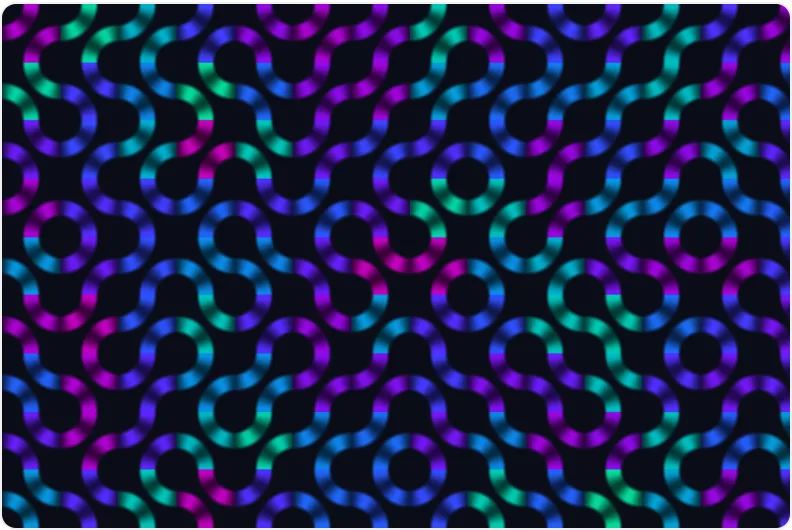
// ═══ typeshade example — truchet tiles (hash-flipped arc maze) ═══//// The truchet construction: tile the plane with ONE tile — two quarter-circle// arcs joining edge midpoints — and let a per-cell hash mirror half the tiles.// The arcs connect across every cell boundary by construction, so a single bit// per cell yields an endless woven maze. Anti-aliased with `fwidth`// (screen-constant line width), energy pulsing along the arcs by angle.// WGSL (WebGPU) + GLSL ES 3.00 (WebGL2).
import {  fn,  module,  f32,  vec2,  vec3,  vec4,  sin,  cos,  floor,  fract,  dot,  mix,  min,  abs,  step,  length,  atan2,  smoothstep,  fwidth,  Let,  f32T,  vec2fT,} from '../src/index.js';import { VsOut, vs, fullscreenUniforms } from './_fullscreen.js';import type { ShaderExample } from './_shared.js';const U = fullscreenUniforms({ tiles: f32T });
// scalar hash of a lattice point → [0,1)const hash = fn('hash', { p: vec2fT }, ({ p }) =>  fract(sin(dot(p, vec2(127.1, 311.7))).mul(43758.5453)),);
const palette = fn('palette', { t: f32T }, ({ t }) => {  const ph = vec3(0.0, 0.33, 0.67);  return vec3(0.5).add(cos(t.add(ph).mul(6.283)).mul(0.5));});
const fs = fn(  'fs',  { vo: VsOut },  ({ vo }) => {    const t = U.field.time;    const res = U.field.resolution;    const asp = res.x.div(res.y);    const q = vec2(vo.uv.x.mul(asp), vo.uv.y).mul(U.field.tiles);    const cell = Let(floor(q));    const f = Let(fract(q));    const h = Let(hash({ p: cell }));    // one hash bit mirrors the tile — arcs still meet across every edge    const fx = mix(f.x, f32(1).sub(f.x), step(0.5, h));    const g = Let(vec2(fx, f.y));    // distance to the two quarter-circle arcs (radius ½, centred on    // opposite tile corners)    const d1 = abs(length(g).sub(0.5));    const d2 = abs(length(g.sub(vec2(1, 1))).sub(0.5));    const d = Let(min(d1, d2));    // screen-constant stroke via fwidth    const aa = Let(fwidth(d).mul(1.4));    const mask = f32(1).sub(smoothstep(f32(0.13).sub(aa), f32(0.13).add(aa), d));    // energy flowing along the arc: parametrise by angle around whichever    // corner owns the nearer arc    const a1 = atan2(g.y, g.x);    const a2 = atan2(g.y.sub(1), g.x.sub(1));    const an = mix(a2, a1, step(d1, d2));    const flow = sin(an.mul(6).add(t.mul(2.5)))      .mul(0.35)      .add(0.65);    // per-cell hue drifting slowly    const col = palette({      t: hash({ p: cell.add(vec2(7.7, 3.1)) })        .mul(0.4)        .add(t.mul(0.05)),    });    const bg = vec3(0.04, 0.05, 0.09);    return vec4(mix(bg, col.mul(flow), mask), 1);  },  { stage: 'fragment', retAttr: '@location(0)' },);
const truchetModule = module({  structs: [U.struct, VsOut.decl],  bindings: [U.binding],  funcs: [vs, fs],});
export const truchet: ShaderExample = {  id: 'truchet',  title: 'Truchet tiles',  blurb:    'One tile — two quarter-circle arcs — mirrored per cell by a hash bit, and the plane weaves itself into an endless maze. fwidth keeps the strokes screen-constant; energy pulses along the arcs. Tile count is live.',  category: 'generic',  file: 'truchet.ts',  module: truchetModule,  renderable: true,  controls: {    time: { kind: 'time' },    resolution: { kind: 'resolution' },    tiles: { kind: 'slider', label: 'Tiles', min: 4, max: 18, step: 1, value: 9 },  },};
struct Uniforms { time: f32, resolution: vec2<f32>, tiles: f32,}
struct VsOut { @builtin(position) pos: vec4<f32>, @location(0) uv: vec2<f32>,}
@group(0) @binding(0) var<uniform> U: Uniforms;
fn hash(p: vec2<f32>) -> f32 { return fract((sin(dot(p, vec2<f32>(127.1, 311.7))) * 43758.5453));}
fn palette(t: f32) -> vec3<f32> { return (vec3<f32>(0.5) + (cos(((t + vec3<f32>(0.0, 0.33, 0.67)) * 6.283)) * 0.5));}
@vertexfn vs(@builtin(vertex_index) vi: u32) -> VsOut { let _cse0 = ((f32((vi & 1u)) * 4.0) - 1.0); let _cse1 = ((f32((vi >> 1u)) * 4.0) - 1.0); return VsOut(vec4<f32>(_cse0, _cse1, 0.0, 1.0), vec2<f32>(((_cse0 * 0.5) + 0.5), ((_cse1 * 0.5) + 0.5)));}
@fragmentfn fs(vo: VsOut) -> @location(0) vec4<f32> { let _cse0 = (vec2<f32>((vo.uv.x * (U.resolution.x / U.resolution.y)), vo.uv.y) * U.tiles); let _v0 = floor(_cse0); let _v1 = fract(_cse0); let _v2 = hash(_v0); let _v3 = vec2<f32>(mix(_v1.x, (1.0 - _v1.x), step(0.5, _v2)), _v1.y); let _cse1 = vec2<f32>(1.0, 1.0); let _gv0 = abs((length(_v3) - 0.5)); let _gv1 = abs((length((_v3 - _cse1)) - 0.5)); let _v4 = min(_gv0, _gv1); let _v5 = (fwidth(_v4) * 1.4); return vec4<f32>(mix(vec3<f32>(0.04, 0.05, 0.09), (palette(((hash((_v0 + vec2<f32>(7.7, 3.1))) * 0.4) + (U.time * 0.05))) * ((sin(((mix(atan2((_v3.y - 1.0), (_v3.x - 1.0)), atan2(_v3.y, _v3.x), step(_gv0, _gv1)) * 6.0) + (U.time * 2.5))) * 0.35) + 0.65)), (1.0 - smoothstep((0.13 - _v5), (0.13 + _v5), _v4))), 1.0);}#version 300 esprecision highp float;precision highp int;
out vec2 uv;
void main() { uint vi = uint(gl_VertexID); float _cse0 = ((float((vi & 1u)) * 4.0) - 1.0); float _cse1 = ((float((vi >> 1u)) * 4.0) - 1.0); gl_Position = vec4(_cse0, _cse1, 0.0, 1.0); uv = vec2(((_cse0 * 0.5) + 0.5), ((_cse1 * 0.5) + 0.5));}#version 300 esprecision highp float;precision highp int;
layout(std140) uniform Uniforms { float time; vec2 resolution; float tiles;} U;float hash(vec2 p) { return fract((sin(dot(p, vec2(127.1, 311.7))) * 43758.5453));}
vec3 palette(float t) { return (vec3(0.5) + (cos(((t + vec3(0.0, 0.33, 0.67)) * 6.283)) * 0.5));}in vec2 uv;layout(location = 0) out vec4 _ret;
void main() { vec2 _cse0 = (vec2((uv.x * (U.resolution.x / U.resolution.y)), uv.y) * U.tiles); vec2 _v0 = floor(_cse0); vec2 _v1 = fract(_cse0); float _v2 = hash(_v0); vec2 _v3 = vec2(mix(_v1.x, (1.0 - _v1.x), step(0.5, _v2)), _v1.y); vec2 _cse1 = vec2(1.0, 1.0); float _gv0 = abs((length(_v3) - 0.5)); float _gv1 = abs((length((_v3 - _cse1)) - 0.5)); float _v4 = min(_gv0, _gv1); float _v5 = (fwidth(_v4) * 1.4); _ret = vec4(mix(vec3(0.04, 0.05, 0.09), (palette(((hash((_v0 + vec2(7.7, 3.1))) * 0.4) + (U.time * 0.05))) * ((sin(((mix(atan((_v3.y - 1.0), (_v3.x - 1.0)), atan(_v3.y, _v3.x), step(_gv0, _gv1)) * 6.0) + (U.time * 2.5))) * 0.35) + 0.65)), (1.0 - smoothstep((0.13 - _v5), (0.13 + _v5), _v4))), 1.0);}Truchet tiles. 빌드할 때 그린 화면입니다.
WGSL과 GLSL 탭은 커밋 c66579bf의 컴파일러가 직접 낸 출력입니다. 컴파일러의 출력 검사가 구워 둔 골든 파일에서 그대로 읽어 왔습니다(emit-goldens.test.ts).
이 예제는 fn() 빌더 API로 작성해서 Playground의 편집기가 받지 않습니다.