 TypeShade
Starfield
텍스처 없이 그린 밤하늘.
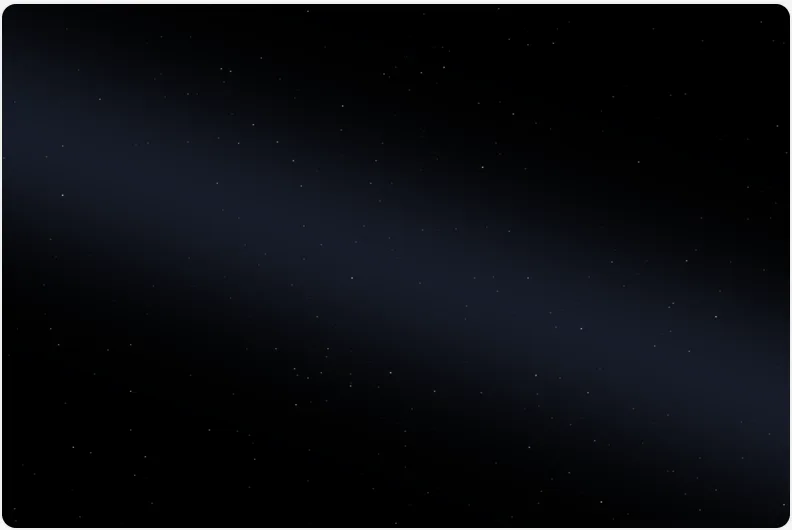
// ═══ typeshade example — starfield (hash grid, parallax layers) ═══//// The classic star field without a single texture: three grid layers, each// cell hashing whether it holds a star, where inside the cell it sits, how it// twinkles — nearer layers drift faster for parallax. A faint diagonal band// stands in for the Milky Way. Showcases procedural hashing as a data source// (the same lattice-hash the noise examples build on, used directly).// WGSL (WebGPU) + GLSL ES 3.00 (WebGL2).
import {  fn,  module,  u32,  f32,  toF32,  vec2,  vec3,  vec4,  sin,  floor,  fract,  mix,  exp,  step,  distance,  smoothstep,  Loop,  Var,  Let,  f32T,  vec2fT,  i32,  u32T,} from '../src/index.js';import { VsOut, vs, fullscreenUniforms, screenCoords } from './_fullscreen.js';import type { ShaderExample } from './_shared.js';const U = fullscreenUniforms({ density: f32T });
// An exact integer hash (lowbias32 with xxHash's primes): every target and the CPU oracle// agree on every bit of it. `fract(sin(x) * 43758.5453)` did not, since WGSL bounds `sin`// only to 2^-11 and the multiply puts that error above the fraction (#184).const hash32 = fn('hash32', { x: u32T }, ({ x }) => {  const a = Let(x.bitXor(x.shr(16)).mul(0x85ebca77));  const b = Let(a.bitXor(a.shr(13)).mul(0xc2b2ae3d));  return b.bitXor(b.shr(16));});
// scalar hash of a lattice point → [0,1): 24 bits, which f32 holds exactlyconst hash = fn('hash', { p: vec2fT }, ({ p }) => {  const h = Let(hash32({ x: u32(i32(p.x)).bitXor(hash32({ x: u32(i32(p.y)) })) }));  return f32(h.shr(8)).mul(5.9604644775390625e-8); // 2^-24, exact: WGSL lets `/` round});
const fs = fn(  'fs',  { vo: VsOut },  ({ vo }) => {    const t = U.field.time;    const res = U.field.resolution;    const p = screenCoords(vo.uv, res);    const col = Var(vec3(0, 0, 0));    // three parallax layers — nearer (coarser) layers drift faster    Loop(      u32(0),      (i) => i.lt(u32(3)),      (i) => {        const fi = toF32(i);        const scale = fi.mul(14).add(18);        const drift = fi.mul(0.014).add(0.01);        const q = vec2(p.x.add(t.mul(drift)), p.y)          .mul(scale)          .add(fi.mul(37.7));        const cell = Let(floor(q));        const f = fract(q);        const h = Let(hash({ p: cell }));        // does this cell hold a star? density raises the hash gate        const gate = step(f32(0.92).sub(U.field.density.mul(0.25)), h);        // star position inside the cell (kept off the cell edges)        const sp = vec2(          hash({ p: cell.add(vec2(12.3, 45.6)) }),          hash({ p: cell.add(vec2(78.9, 1.2)) }),        )          .mul(0.7)          .add(0.15);        const d = distance(f, sp);        const rad = f32(0.06).sub(fi.mul(0.012)); // far layers are smaller        const core = Let(f32(1).sub(smoothstep(0, rad, d)));        const twinkle = sin(t.mul(h.mul(4).add(2)).add(h.mul(40)))          .mul(0.4)          .add(0.6);        const b = core          .mul(core)          .mul(twinkle)          .mul(gate)          .mul(f32(1).sub(fi.mul(0.25)));        // colour temperature from the hash: blue-white ↔ warm        const tint = mix(vec3(0.75, 0.85, 1.0), vec3(1.0, 0.9, 0.75), h);        col.assign(col.add(tint.mul(b)));      },    );    // a faint diagonal Milky-Way band    const s = Let(p.y.add(p.x.mul(0.35)));    const band = exp(s.mul(s).mul(6).neg());    return vec4(col.add(vec3(0.09, 0.11, 0.16).mul(band)), 1);  },  { stage: 'fragment', retAttr: '@location(0)' },);
const starfieldModule = module({  structs: [U.struct, VsOut.decl],  bindings: [U.binding],  funcs: [vs, fs],});
export const starfield: ShaderExample = {  id: 'starfield',  title: 'Starfield',  blurb:    'A textureless night sky — three hash-grid layers decide per cell whether a star exists, where it sits, and how it twinkles; nearer layers drift faster for parallax. Density is live.',  category: 'generic',  file: 'starfield.ts',  module: starfieldModule,  renderable: true,  controls: {    time: { kind: 'time' },    resolution: { kind: 'resolution' },    density: { kind: 'slider', label: 'Density', min: 0, max: 1, step: 0.05, value: 0.5 },  },};
struct Uniforms { time: f32, resolution: vec2<f32>, density: f32,}
struct VsOut { @builtin(position) pos: vec4<f32>, @location(0) uv: vec2<f32>,}
@group(0) @binding(0) var<uniform> U: Uniforms;
fn hash32(x: u32) -> u32 { let _v0 = ((x ^ (x >> 16u)) * 2246822519u); let _v1 = ((_v0 ^ (_v0 >> 13u)) * 3266489917u); return (_v1 ^ (_v1 >> 16u));}
fn hash(p: vec2<f32>) -> f32 { let _v0 = hash32((u32(i32(p.x)) ^ hash32(u32(i32(p.y))))); return (f32((_v0 >> 8u)) * 5.960464477539063e-8);}
@vertexfn vs(@builtin(vertex_index) vi: u32) -> VsOut { let _cse0 = ((f32((vi & 1u)) * 4.0) - 1.0); let _cse1 = ((f32((vi >> 1u)) * 4.0) - 1.0); return VsOut(vec4<f32>(_cse0, _cse1, 0.0, 1.0), vec2<f32>(((_cse0 * 0.5) + 0.5), ((_cse1 * 0.5) + 0.5)));}
@fragmentfn fs(vo: VsOut) -> @location(0) vec4<f32> { let _licm0 = U.time; let _licm1 = vec2<f32>(12.3, 45.6); let _licm2 = vec2<f32>(78.9, 1.2); let _licm3 = vec3<f32>(0.75, 0.85, 1.0); let _licm4 = vec3<f32>(1.0, 0.9, 0.75); let _licm5 = (0.92 - (U.density * 0.25)); var _v0: vec3<f32> = vec3<f32>(0.0, 0.0, 0.0); let _cse2 = vec2<f32>((((vo.uv.x * 2.0) - 1.0) * (U.resolution.x / U.resolution.y)), ((vo.uv.y * 2.0) - 1.0)); let _cse0 = _cse2.x; let _cse1 = _cse2.y; for (var _v1: u32 = 0u; (_v1 < 3u); _v1 = (_v1 + 1u)) { let _gv0 = f32(_v1); let _gv1 = ((vec2<f32>((_cse0 + (_licm0 * ((_gv0 * 0.014) + 0.01))), _cse1) * ((_gv0 * 14.0) + 18.0)) + (_gv0 * 37.7)); let _v2 = floor(_gv1); let _v3 = hash(_v2); let _v4 = (1.0 - smoothstep(0.0, (0.06 - (_gv0 * 0.012)), distance(fract(_gv1), ((vec2<f32>(hash((_v2 + _licm1)), hash((_v2 + _licm2))) * 0.7) + 0.15)))); _v0 = (_v0 + (mix(_licm3, _licm4, _v3) * ((((_v4 * _v4) * ((sin(((_licm0 * ((_v3 * 4.0) + 2.0)) + (_v3 * 40.0))) * 0.4) + 0.6)) * step(_licm5, _v3)) * (1.0 - (_gv0 * 0.25))))); } let _v5 = (_cse1 + (_cse0 * 0.35)); return vec4<f32>((_v0 + (vec3<f32>(0.09, 0.11, 0.16) * exp((-((_v5 * _v5) * 6.0))))), 1.0);}#version 300 esprecision highp float;precision highp int;
out vec2 uv;
void main() { uint vi = uint(gl_VertexID); float _cse0 = ((float((vi & 1u)) * 4.0) - 1.0); float _cse1 = ((float((vi >> 1u)) * 4.0) - 1.0); gl_Position = vec4(_cse0, _cse1, 0.0, 1.0); uv = vec2(((_cse0 * 0.5) + 0.5), ((_cse1 * 0.5) + 0.5));}#version 300 esprecision highp float;precision highp int;
layout(std140) uniform Uniforms { float time; vec2 resolution; float density;} U;int _f2i(float x) { return int(mix(clamp(x, -2147483648.0, 2147483520.0), 0.0, isnan(x)));}uint hash32(uint x) { uint _v0 = ((x ^ (x >> 16u)) * 2246822519u); uint _v1 = ((_v0 ^ (_v0 >> 13u)) * 3266489917u); return (_v1 ^ (_v1 >> 16u));}
float hash(vec2 p) { uint _v0 = hash32((uint(_f2i(p.x)) ^ hash32(uint(_f2i(p.y))))); return (float((_v0 >> 8u)) * 5.960464477539063e-8);}in vec2 uv;layout(location = 0) out vec4 _ret;
void main() { float _licm0 = U.time; vec2 _licm1 = vec2(12.3, 45.6); vec2 _licm2 = vec2(78.9, 1.2); vec3 _licm3 = vec3(0.75, 0.85, 1.0); vec3 _licm4 = vec3(1.0, 0.9, 0.75); float _licm5 = (0.92 - (U.density * 0.25)); vec3 _v0 = vec3(0.0, 0.0, 0.0); vec2 _cse2 = vec2((((uv.x * 2.0) - 1.0) * (U.resolution.x / U.resolution.y)), ((uv.y * 2.0) - 1.0)); float _cse0 = _cse2.x; float _cse1 = _cse2.y; for (uint _v1 = 0u; (_v1 < 3u); _v1 = (_v1 + 1u)) { float _gv0 = float(_v1); vec2 _gv1 = ((vec2((_cse0 + (_licm0 * ((_gv0 * 0.014) + 0.01))), _cse1) * ((_gv0 * 14.0) + 18.0)) + (_gv0 * 37.7)); vec2 _v2 = floor(_gv1); float _v3 = hash(_v2); float _v4 = (1.0 - smoothstep(0.0, (0.06 - (_gv0 * 0.012)), distance(fract(_gv1), ((vec2(hash((_v2 + _licm1)), hash((_v2 + _licm2))) * 0.7) + 0.15)))); _v0 = (_v0 + (mix(_licm3, _licm4, _v3) * ((((_v4 * _v4) * ((sin(((_licm0 * ((_v3 * 4.0) + 2.0)) + (_v3 * 40.0))) * 0.4) + 0.6)) * step(_licm5, _v3)) * (1.0 - (_gv0 * 0.25))))); } float _v5 = (_cse1 + (_cse0 * 0.35)); _ret = vec4((_v0 + (vec3(0.09, 0.11, 0.16) * exp((-((_v5 * _v5) * 6.0))))), 1.0);}Starfield. 빌드할 때 그린 화면입니다.
WGSL과 GLSL 탭은 커밋 c66579bf의 컴파일러가 직접 낸 출력입니다. 컴파일러의 출력 검사가 구워 둔 골든 파일에서 그대로 읽어 왔습니다(emit-goldens.test.ts).
이 예제는 fn() 빌더 API로 작성해서 Playground의 편집기가 받지 않습니다.