 TypeShade
Metaballs
음함수로 그린 방울.
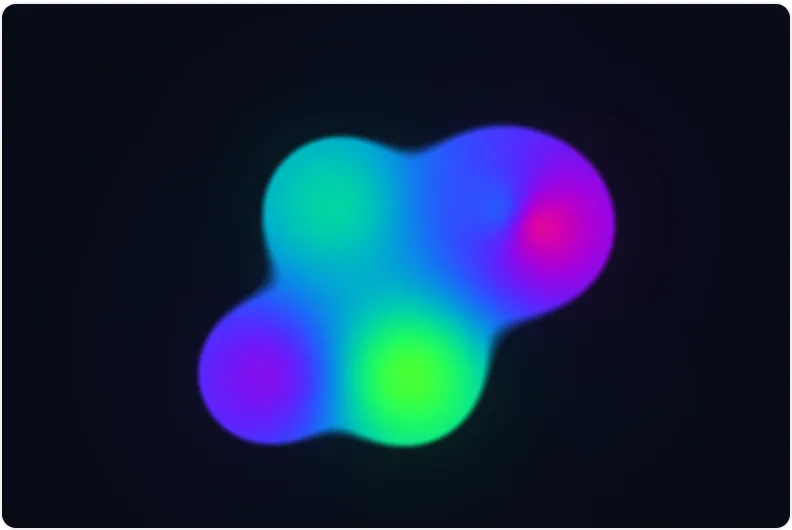
// ═══ typeshade example — metaballs (implicit blob field) ═══//// The classic 2D metaballs: each ball contributes an inverse-square field// w = k/d², the fields SUM, and the iso-contour of the summed field is the// blobby silhouette that merges and splits as the balls orbit. Colour is the// field-weighted blob index through a cosine palette, so blobs keep their hue// while blending where they touch. Showcases a Loop accumulator over a// uniform-driven ball count. WGSL (WebGPU) + GLSL ES 3.00 (WebGL2).
import {  fn,  module,  u32,  f32,  toF32,  vec2,  vec3,  vec4,  sin,  cos,  dot,  max,  mix,  smoothstep,  Loop,  Var,  Let,  f32T,  vec4fT,} from '../src/index.js';import { VsOut, vs, fullscreenUniforms, screenCoords } from './_fullscreen.js';import type { ShaderExample } from './_shared.js';const U = fullscreenUniforms({ count: f32T, mouse: vec4fT });
const palette = fn('palette', { t: f32T }, ({ t }) => {  const ph = vec3(0.0, 0.33, 0.67);  return vec3(0.5).add(cos(t.add(ph).mul(6.283)).mul(0.5));});
const fs = fn(  'fs',  { vo: VsOut },  ({ vo }) => {    const t = U.field.time;    const res = U.field.resolution;    const p = screenCoords(vo.uv, res);    // once the pointer has entered (m.w = 1), ball 0 leaves its orbit and    // follows the cursor — mapped to the same isotropic space as p    const m = U.field.mouse;    const cursor = Let(screenCoords(vec2(m.x.div(res.x), m.y.div(res.y)), res));    // sum the inverse-square fields; hue accumulates field-weighted so merged    // blobs blend their colours in proportion to who dominates the pixel    const field = Var(f32(0));    const hue = Var(f32(0));    Loop(      u32(0),      (i) => toF32(i).lt(U.field.count),      (i) => {        const fi = toF32(i);        const orbit = vec2(          sin(t.mul(fi.mul(0.13).add(0.5)).add(fi.mul(2.4))).mul(0.55),          cos(t.mul(fi.mul(0.11).add(0.4)).add(fi.mul(1.7))).mul(0.42),        );        // ball 0 → cursor when interacted: step(fi, 0.5) selects i == 0        const follow = f32(1)          .sub(smoothstep(0.4, 0.6, fi))          .mul(m.w);        const ctr = mix(orbit, cursor, follow);        const d = Let(p.sub(ctr));        const w = Let(f32(0.055).div(dot(d, d).add(0.003)));        field.assign(field.add(w));        hue.assign(hue.add(w.mul(fi)));      },    );    // iso-contour of the summed field = the blob silhouette    const iso = smoothstep(0.95, 1.15, field);    const blob = palette({ t: hue.div(max(field, 0.0001)).mul(0.15).add(t.mul(0.03)) });    // outside: dark bg lit by a faint field glow; inside: the full blob colour    const bg = vec3(0.03, 0.04, 0.08).add(blob.mul(field.mul(0.08)));    return vec4(mix(bg, blob, iso), 1);  },  { stage: 'fragment', retAttr: '@location(0)' },);
const metaballsModule = module({  structs: [U.struct, VsOut.decl],  bindings: [U.binding],  funcs: [vs, fs],});
export const metaballs: ShaderExample = {  id: 'metaballs',  title: 'Metaballs',  blurb:    'Implicit blobs — each ball adds an inverse-square field, the fields sum, and the iso-contour merges and splits as they orbit. Move the pointer and one ball follows it into the swarm. Ball count is live.',  category: 'generic',  file: 'metaballs.ts',  module: metaballsModule,  renderable: true,  controls: {    time: { kind: 'time' },    resolution: { kind: 'resolution' },    count: { kind: 'slider', label: 'Balls', min: 2, max: 6, step: 1, value: 5 },    mouse: { kind: 'mouse' },  },};
struct Uniforms { time: f32, resolution: vec2<f32>, count: f32, mouse: vec4<f32>,}
struct VsOut { @builtin(position) pos: vec4<f32>, @location(0) uv: vec2<f32>,}
@group(0) @binding(0) var<uniform> U: Uniforms;
fn palette(t: f32) -> vec3<f32> { return (vec3<f32>(0.5) + (cos(((t + vec3<f32>(0.0, 0.33, 0.67)) * 6.283)) * 0.5));}
@vertexfn vs(@builtin(vertex_index) vi: u32) -> VsOut { let _cse0 = ((f32((vi & 1u)) * 4.0) - 1.0); let _cse1 = ((f32((vi >> 1u)) * 4.0) - 1.0); return VsOut(vec4<f32>(_cse0, _cse1, 0.0, 1.0), vec2<f32>(((_cse0 * 0.5) + 0.5), ((_cse1 * 0.5) + 0.5)));}
@fragmentfn fs(vo: VsOut) -> @location(0) vec4<f32> { let _licm0 = U.count; let _licm1 = ((vo.uv.x * 2.0) - 1.0); let _licm2 = ((vo.uv.y * 2.0) - 1.0); let _licm3 = U.time; let _licm4 = U.mouse.w; let _cse0 = vec2<f32>((U.mouse.x / U.resolution.x), (U.mouse.y / U.resolution.y)); let _cse1 = (U.resolution.x / U.resolution.y); let _v0 = vec2<f32>((((_cse0.x * 2.0) - 1.0) * _cse1), ((_cse0.y * 2.0) - 1.0)); var _v1: f32 = 0.0; var _v2: f32 = 0.0; for (var _v3: u32 = 0u; (f32(_v3) < _licm0); _v3 = (_v3 + 1u)) { let _gv0 = f32(_v3); let _v4 = (vec2<f32>((_licm1 * _cse1), _licm2) - mix(vec2<f32>((sin(((_licm3 * ((_gv0 * 0.13) + 0.5)) + (_gv0 * 2.4))) * 0.55), (cos(((_licm3 * ((_gv0 * 0.11) + 0.4)) + (_gv0 * 1.7))) * 0.42)), _v0, ((1.0 - smoothstep(0.4, 0.6, _gv0)) * _licm4))); let _v5 = (0.055 / (dot(_v4, _v4) + 0.003)); _v1 = (_v1 + _v5); _v2 = (_v2 + (_v5 * _gv0)); } let _cse2 = (_licm3 * 0.03); let _lc1 = palette((((_v2 / max(_v1, 0.0001)) * 0.15) + _cse2)); return vec4<f32>(mix((vec3<f32>(0.03, 0.04, 0.08) + (_lc1 * (_v1 * 0.08))), _lc1, smoothstep(0.95, 1.15, _v1)), 1.0);}#version 300 esprecision highp float;precision highp int;
out vec2 uv;
void main() { uint vi = uint(gl_VertexID); float _cse0 = ((float((vi & 1u)) * 4.0) - 1.0); float _cse1 = ((float((vi >> 1u)) * 4.0) - 1.0); gl_Position = vec4(_cse0, _cse1, 0.0, 1.0); uv = vec2(((_cse0 * 0.5) + 0.5), ((_cse1 * 0.5) + 0.5));}#version 300 esprecision highp float;precision highp int;
layout(std140) uniform Uniforms { float time; vec2 resolution; float count; vec4 mouse;} U;vec3 palette(float t) { return (vec3(0.5) + (cos(((t + vec3(0.0, 0.33, 0.67)) * 6.283)) * 0.5));}in vec2 uv;layout(location = 0) out vec4 _ret;
void main() { float _licm0 = U.count; float _licm1 = ((uv.x * 2.0) - 1.0); float _licm2 = ((uv.y * 2.0) - 1.0); float _licm3 = U.time; float _licm4 = U.mouse.w; vec2 _cse0 = vec2((U.mouse.x / U.resolution.x), (U.mouse.y / U.resolution.y)); float _cse1 = (U.resolution.x / U.resolution.y); vec2 _v0 = vec2((((_cse0.x * 2.0) - 1.0) * _cse1), ((_cse0.y * 2.0) - 1.0)); float _v1 = 0.0; float _v2 = 0.0; for (uint _v3 = 0u; (float(_v3) < _licm0); _v3 = (_v3 + 1u)) { float _gv0 = float(_v3); vec2 _v4 = (vec2((_licm1 * _cse1), _licm2) - mix(vec2((sin(((_licm3 * ((_gv0 * 0.13) + 0.5)) + (_gv0 * 2.4))) * 0.55), (cos(((_licm3 * ((_gv0 * 0.11) + 0.4)) + (_gv0 * 1.7))) * 0.42)), _v0, ((1.0 - smoothstep(0.4, 0.6, _gv0)) * _licm4))); float _v5 = (0.055 / (dot(_v4, _v4) + 0.003)); _v1 = (_v1 + _v5); _v2 = (_v2 + (_v5 * _gv0)); } float _cse2 = (_licm3 * 0.03); vec3 _lc1 = palette((((_v2 / max(_v1, 0.0001)) * 0.15) + _cse2)); _ret = vec4(mix((vec3(0.03, 0.04, 0.08) + (_lc1 * (_v1 * 0.08))), _lc1, smoothstep(0.95, 1.15, _v1)), 1.0);}Metaballs. 빌드할 때 그린 화면입니다.
WGSL과 GLSL 탭은 커밋 c66579bf의 컴파일러가 직접 낸 출력입니다. 컴파일러의 출력 검사가 구워 둔 골든 파일에서 그대로 읽어 왔습니다(emit-goldens.test.ts).
이 예제는 fn() 빌더 API로 작성해서 Playground의 편집기가 받지 않습니다.