 TypeShade
fp64 catastrophic cancellation
수치해석 교과서의 그 그래프를 GPU로 그립니다.
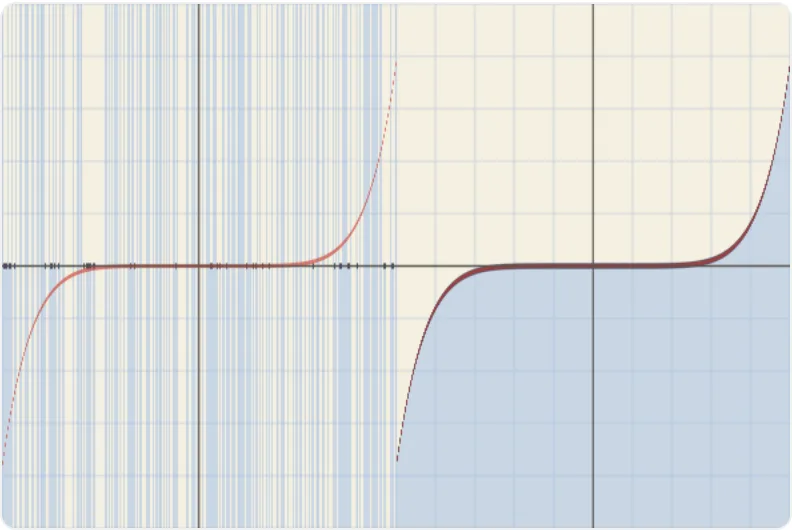
// ═══ typeshade example — fp64 catastrophic cancellation ═══//// The numerics-textbook figure, live on the GPU: (x−1)⁷ EVALUATED IN EXPANDED// FORM (x⁷ − 7x⁶ + 21x⁵ − 35x⁴ + 35x³ − 21x² + 7x − 1) near x = 1. The terms// are all ~1 while the true value is ~w⁷ ≈ 10⁻⁹ — eight ~1-sized numbers must// cancel to nine digits, which f32 (7 digits) cannot do AT ALL: its result is// ±5×10⁻⁶ NOISE, thousands of times the whole plot range (CPU-verified:// 7300× signal). The df64 side (~14 digits) hugs the true curve. The thin// reference line is the FACTORED form ((x−1)⁷ — subtract first, no// cancellation), which even f32 evaluates cleanly: the fix is always to// restructure the math, and fp64 is for when you can't.//// Narrow the half-width slider and even df64 starts to fray (w⁷ sinks toward// its ~14-digit floor) — the same budget wall, two decades further out.//// The `_fp64` guard uniform is auto-injected by the lowering; the render// harnesses bind it to 1.0f by probing the program for the Fp64Guard block.
import {  fn,  module,  vec3,  vec4,  f32,  f64,  pow,  fract,  abs,  min,  mix,  step,  smoothstep,  toF32,  toF64,  f32T,  vec2fT,  Let,  uniformStruct,} from '../src/index.js';import { VsOut, vs } from './_fullscreen.js';import type { ShaderExample } from './_shared.js';
const U = uniformStruct(  'Uniforms',  { group: 0, binding: 0, as: 'u' },  {    resolution: vec2fT,    half_width: f32T, // plot spans x ∈ [1−w, 1+w]    fp64: f32T, // toggle: 1 = split-screen f32 | f64 (canonical), 0 = all-f32  },);
const fsCancel = fn(  'fs_cancel',  { vo: VsOut },  (p) => {    const w = Let(U.field.half_width);    const halfUv = Let(p.vo.uv.x.mul(2.0));    const sx = Let(halfUv.sub(p.vo.uv.x.lt(0.5).select(0.0, 1.0)));    const u = Let(sx.sub(0.5).mul(w.mul(2.0))); // x − 1 ∈ [−w, w]
    const isF32 = Let(p.vo.uv.x.lt(0.5).or(U.field.fp64.lt(0.5)));    // f64 — the expanded polynomial, every term in extended precision; only    // the ~w⁷-sized RESULT narrows (small values narrow harmlessly: f32    // precision is relative).    const xd = Let(f64(1).add(toF64(u)));    const x2 = Let(xd.mul(xd));    const x3 = Let(x2.mul(xd));    const x4 = Let(x2.mul(x2));    const x5 = Let(x4.mul(xd));    const x6 = Let(x3.mul(x3));    const x7 = Let(x6.mul(xd));    const p64 = Let(      toF32(        x7          .sub(x6.mul(7.0))          .add(x5.mul(21.0))          .sub(x4.mul(35.0))          .add(x3.mul(35.0))          .sub(x2.mul(21.0))          .add(xd.mul(7.0))          .sub(1.0),      ),    );    // f32 twin — SAME expanded polynomial: eight ~1-sized terms, seven digits.    const xf = Let(f32(1).add(u));    const f2 = Let(xf.mul(xf));    const f3 = Let(f2.mul(xf));    const f4 = Let(f2.mul(f2));    const f5 = Let(f4.mul(xf));    const f6 = Let(f3.mul(f3));    const f7 = Let(f6.mul(xf));    const p32 = Let(      f7        .sub(f6.mul(7.0))        .add(f5.mul(21.0))        .sub(f4.mul(35.0))        .add(f3.mul(35.0))        .sub(f2.mul(21.0))        .add(xf.mul(7.0))        .sub(1.0),    );    const pv = Let(isF32.select(p32, p64));
    // Plot in units of the true amplitude w⁷ (the picture is w-invariant).    const yscale = Let(pow(w, f32(7)).mul(1.3));    const v = Let(pv.div(yscale)); // computed curve, ±0.77 at the edges    const u2 = Let(u.mul(u));    const truth = Let(u2.mul(u2).mul(u2).mul(u).div(yscale)); // factored (x−1)⁷ — no cancellation    const py = Let(p.vo.uv.y.sub(0.5).mul(2.0));    const px = Let(f32(2).div(U.field.resolution.y)); // plot-units per pixel
    // Graph-paper styling: parchment with a pale grid (10 columns per half,    // 0.2-plot-unit rows), ink axes.    const gxf = Let(fract(sx.mul(10.0)));    const gyf = Let(fract(py.add(1.0).mul(5.0)));    const dgx = Let(min(gxf, f32(1).sub(gxf))); // distance to column line, in cells    const dgy = Let(min(gyf, f32(1).sub(gyf)));    const aaCx = Let(f32(30).div(U.field.resolution.x)); // ~1.5 px in cell units    const aaCy = Let(f32(15).div(U.field.resolution.y));    const grid = Let(      f32(1)        .sub(smoothstep(f32(0), aaCx, dgx))        .add(f32(1).sub(smoothstep(f32(0), aaCy, dgy))),    );    const paper = vec3(0.96, 0.94, 0.88);    const rgb0 = Let(mix(paper, vec3(0.72, 0.78, 0.86), min(grid, f32(1)).mul(0.45)));
    // Fill below the computed curve — its BOUNDARY is the visible verdict:    // a smooth odd curve on the f64 side, a full-height noise barcode on f32.    const fill = Let(step(py, v));    const rgb1 = Let(mix(rgb0, vec3(0.62, 0.74, 0.9), fill.mul(0.5)));    // Ink the computed curve where it is on-screen and locally flat enough.    const ink = Let(f32(1).sub(smoothstep(px.mul(1.2), px.mul(3.0), abs(v.sub(py)))));    const rgb2 = Let(mix(rgb1, vec3(0.13, 0.16, 0.3), ink.mul(0.85)));    // The factored-form reference in warm red — clean on BOTH halves.    const ref = Let(f32(1).sub(smoothstep(px.mul(0.8), px.mul(2.2), abs(truth.sub(py)))));    const rgb3 = Let(mix(rgb2, vec3(0.8, 0.25, 0.2), ref.mul(0.65)));    // Axes: y = 0 and x = 1 (the cancellation point).    const axis = Let(      min(        smoothstep(f32(0), px.mul(1.5), abs(py)),        smoothstep(f32(0), px.mul(1.5), abs(sx.sub(0.5)).mul(2.0)),      ),    );    const rgb = Let(mix(vec3(0.35, 0.33, 0.3), rgb3, axis));    return vec4(rgb, f32(1));  },  { stage: 'fragment', retAttr: '@location(0)' },);
// `_fp64` guard lands at (group 0, binding 1) automatically.const fp64CancellationModule = module({  funcs: [vs, fsCancel],  uses: [U, VsOut],});
export const fp64Cancellation: ShaderExample = {  id: 'fp64-cancellation',  title: 'fp64 catastrophic cancellation',  blurb:    'The numerics-textbook plot on a GPU: (x−1)⁷ evaluated in EXPANDED form near x = 1 — eight ~1-sized terms must cancel to nine digits. f32 (left) returns pure noise thousands of times the plot range; emulated f64 (right) hugs the true curve. The thin red reference is the FACTORED form, which even f32 nails — restructure the math when you can, reach for fp64 when you can’t. Narrow the width slider and watch df64 hit its own wall two decades later.',  category: 'generic',  file: 'fp64-cancellation.ts',  module: fp64CancellationModule,  renderable: true,  splitLabels: ['f32 expanded', 'f64 expanded'],  controls: {    resolution: { kind: 'resolution' },    half_width: {      kind: 'slider',      label: 'Half-width w',      min: 0.012,      max: 0.12,      step: 0.002,      value: 0.05,      wheel: true,    },    fp64: { kind: 'toggle', label: 'fp64 emulation', value: true },  },};
struct Uniforms { resolution: vec2<f32>, half_width: f32, fp64: f32,}
struct VsOut { @builtin(position) pos: vec4<f32>, @location(0) uv: vec2<f32>,}
@group(0) @binding(0) var<uniform> u: Uniforms;@group(0) @binding(1) var _fp64: texture_2d<f32>;
@vertexfn vs(@builtin(vertex_index) vi: u32) -> VsOut { let _cse0 = ((f32((vi & 1u)) * 4.0) - 1.0); let _cse1 = ((f32((vi >> 1u)) * 4.0) - 1.0); return VsOut(vec4<f32>(_cse0, _cse1, 0.0, 1.0), vec2<f32>(((_cse0 * 0.5) + 0.5), ((_cse1 * 0.5) + 0.5)));}
@fragmentfn fs_cancel(vo: VsOut) -> @location(0) vec4<f32> { let _fp64_g = textureLoad(_fp64, vec2<i32>(0, 0), 0).x; let _v0 = u.half_width; let _v1 = (vo.uv.x * 2.0); let _cse0 = (vo.uv.x < 0.5); let _v2 = (_v1 - select(1.0, 0.0, _cse0)); let _gv0 = (_v2 - 0.5); let _v3 = (_gv0 * (_v0 * 2.0)); let _v4 = (_cse0 || (u.fp64 < 0.5)); let _cse1 = vec2<f32>(1.0, 0.0); let _v5 = df64_add(_cse1, vec2<f32>(_v3, 0.0), _fp64_g); let _v6 = df64_sqr(_v5, _fp64_g); let _v7 = df64_mul(_v6, _v5, _fp64_g); let _v8 = df64_sqr(_v6, _fp64_g); let _v9 = df64_mul(_v8, _v5, _fp64_g); let _v10 = df64_sqr(_v7, _fp64_g); let _v11 = df64_mul(_v10, _v5, _fp64_g); let _cse6 = bitcast<f32>(bitcast<u32>(0.0)); let _cse2 = vec2<f32>(_cse6, _cse6); let _cse3 = vec2<f32>(7.0, 0.0); let _cse4 = vec2<f32>(21.0, 0.0); let _cse5 = vec2<f32>(35.0, 0.0); let _v12 = df64_narrow(df64_sub(df64_add(df64_sub(df64_add(df64_sub(df64_add(df64_sub(df64_add(_v11, _cse2, _fp64_g), df64_mul(_v10, _cse3, _fp64_g), _fp64_g), df64_mul(_v9, _cse4, _fp64_g), _fp64_g), df64_mul(_v8, _cse5, _fp64_g), _fp64_g), df64_mul(_v7, _cse5, _fp64_g), _fp64_g), df64_mul(_v6, _cse4, _fp64_g), _fp64_g), df64_mul(_v5, _cse3, _fp64_g), _fp64_g), df64_add(_cse1, _cse2, _fp64_g), _fp64_g)); let _v13 = (1.0 + _v3); let _v14 = (_v13 * _v13); let _v15 = (_v14 * _v13); let _v16 = (_v14 * _v14); let _v17 = (_v16 * _v13); let _v18 = (_v15 * _v15); let _v19 = (_v18 * _v13); let _v20 = (((((((_v19 - (_v18 * 7.0)) + (_v17 * 21.0)) - (_v16 * 35.0)) + (_v15 * 35.0)) - (_v14 * 21.0)) + (_v13 * 7.0)) - 1.0); let _v21 = select(_v12, _v20, _v4); let _v22 = (pow(_v0, 7.0) * 1.3); let _v23 = (_v21 / _v22); let _v24 = (_v3 * _v3); let _v25 = ((((_v24 * _v24) * _v24) * _v3) / _v22); let _v26 = ((vo.uv.y - 0.5) * 2.0); let _v27 = (2.0 / u.resolution.y); let _v28 = fract((_v2 * 10.0)); let _v29 = fract(((_v26 + 1.0) * 5.0)); let _v30 = min(_v28, (1.0 - _v28)); let _v31 = min(_v29, (1.0 - _v29)); let _v32 = (30.0 / u.resolution.x); let _v33 = (15.0 / u.resolution.y); let _v34 = ((1.0 - smoothstep(0.0, _v32, _v30)) + (1.0 - smoothstep(0.0, _v33, _v31))); let _v35 = mix(vec3<f32>(0.96, 0.94, 0.88), vec3<f32>(0.72, 0.78, 0.86), (min(_v34, 1.0) * 0.45)); let _v36 = step(_v26, _v23); let _v37 = mix(_v35, vec3<f32>(0.62, 0.74, 0.9), (_v36 * 0.5)); let _v38 = (1.0 - smoothstep((_v27 * 1.2), (_v27 * 3.0), abs((_v23 - _v26)))); let _v39 = mix(_v37, vec3<f32>(0.13, 0.16, 0.3), (_v38 * 0.85)); let _v40 = (1.0 - smoothstep((_v27 * 0.8), (_v27 * 2.2), abs((_v25 - _v26)))); let _v41 = mix(_v39, vec3<f32>(0.8, 0.25, 0.2), (_v40 * 0.65)); let _lc0 = (_v27 * 1.5); let _v42 = min(smoothstep(0.0, _lc0, abs(_v26)), smoothstep(0.0, _lc0, (abs(_gv0) * 2.0))); let _v43 = mix(vec3<f32>(0.35, 0.33, 0.3), _v41, _v42); return vec4<f32>(_v43, 1.0);}
fn df64_twoSum(a: f32, b: f32, _fp64_g: f32) -> vec2<f32> { let _v0 = (a + b); let _v1 = (((_v0 * _fp64_g) - a) * _fp64_g); let _v2 = (((a - ((_v0 - _v1) * _fp64_g)) * _fp64_g) + (b - _v1)); return vec2<f32>(_v0, _v2);}
fn df64_quickTwoSum(a: f32, b: f32, _fp64_g: f32) -> vec2<f32> { let _v0 = ((a + b) * _fp64_g); let _v1 = (b - ((_v0 - a) * _fp64_g)); return vec2<f32>(_v0, _v1);}
fn df64_split(a: f32, _fp64_g: f32) -> vec2<f32> { let _v0 = (a * (_fp64_g * 4097.0)); let _v1 = ((_v0 * _fp64_g) - (_v0 - a)); let _v2 = ((a * _fp64_g) - _v1); return vec2<f32>(_v1, _v2);}
fn df64_twoProd(a: f32, b: f32, _fp64_g: f32) -> vec2<f32> { let _v0 = (a * b); let _v1 = df64_split(a, _fp64_g); let _v2 = df64_split(b, _fp64_g); let _v3 = (((((_v1.x * _v2.x) - _v0) + (_v1.x * _v2.y)) + (_v1.y * _v2.x)) + (_v1.y * _v2.y)); return vec2<f32>(_v0, _v3);}
fn df64_twoSqr(a: f32, _fp64_g: f32) -> vec2<f32> { let _v0 = (a * a); let _v1 = df64_split(a, _fp64_g); let _v2 = (((((_v1.x * _v1.x) - _v0) * _fp64_g) + (((_v1.x * _v1.y) * 2.0) * _fp64_g)) + ((_v1.y * _v1.y) * _fp64_g)); return vec2<f32>(_v0, _v2);}
fn df64_add(a: vec2<f32>, b: vec2<f32>, _fp64_g: f32) -> vec2<f32> { var _v0: vec2<f32> = df64_twoSum(a.x, b.x, _fp64_g); let _v1 = df64_twoSum(a.y, b.y, _fp64_g); _v0.y = (_v0.y + _v1.x); _v0 = df64_quickTwoSum(_v0.x, _v0.y, _fp64_g); _v0.y = (_v0.y + _v1.y); _v0 = df64_quickTwoSum(_v0.x, _v0.y, _fp64_g); return _v0;}
fn df64_sub(a: vec2<f32>, b: vec2<f32>, _fp64_g: f32) -> vec2<f32> { return df64_add(a, (-b), _fp64_g);}
fn df64_mul(a: vec2<f32>, b: vec2<f32>, _fp64_g: f32) -> vec2<f32> { var _v0: vec2<f32> = df64_twoProd(a.x, b.x, _fp64_g); _v0.y = (_v0.y + (a.x * b.y)); _v0 = df64_quickTwoSum(_v0.x, _v0.y, _fp64_g); _v0.y = (_v0.y + (a.y * b.x)); return df64_quickTwoSum(_v0.x, _v0.y, _fp64_g);}
fn df64_sqr(a: vec2<f32>, _fp64_g: f32) -> vec2<f32> { var _v0: vec2<f32> = df64_twoSqr(a.x, _fp64_g); _v0.y = (_v0.y + ((a.x * a.y) * 2.0)); return df64_quickTwoSum(_v0.x, _v0.y, _fp64_g);}
fn df64_narrow(a: vec2<f32>) -> f32 { return (a.x + a.y);}#version 300 esprecision highp float;precision highp int;
out vec2 uv;
void main() { uint vi = uint(gl_VertexID); float _cse0 = ((float((vi & 1u)) * 4.0) - 1.0); float _cse1 = ((float((vi >> 1u)) * 4.0) - 1.0); gl_Position = vec4(_cse0, _cse1, 0.0, 1.0); uv = vec2(((_cse0 * 0.5) + 0.5), ((_cse1 * 0.5) + 0.5));}#version 300 esprecision highp float;precision highp int;
layout(std140) uniform Uniforms { vec2 resolution; float half_width; float fp64;} u;
uniform highp sampler2D _fp64;vec2 df64_twoSum(float a, float b, float _fp64_g) { float _v0 = (a + b); float _v1 = (((_v0 * _fp64_g) - a) * _fp64_g); float _v2 = (((a - ((_v0 - _v1) * _fp64_g)) * _fp64_g) + (b - _v1)); return vec2(_v0, _v2);}
vec2 df64_quickTwoSum(float a, float b, float _fp64_g) { float _v0 = ((a + b) * _fp64_g); float _v1 = (b - ((_v0 - a) * _fp64_g)); return vec2(_v0, _v1);}
vec2 df64_split(float a, float _fp64_g) { float _v0 = (a * (_fp64_g * 4097.0)); float _v1 = ((_v0 * _fp64_g) - (_v0 - a)); float _v2 = ((a * _fp64_g) - _v1); return vec2(_v1, _v2);}
vec2 df64_twoProd(float a, float b, float _fp64_g) { float _v0 = (a * b); vec2 _v1 = df64_split(a, _fp64_g); vec2 _v2 = df64_split(b, _fp64_g); float _v3 = (((((_v1.x * _v2.x) - _v0) + (_v1.x * _v2.y)) + (_v1.y * _v2.x)) + (_v1.y * _v2.y)); return vec2(_v0, _v3);}
vec2 df64_twoSqr(float a, float _fp64_g) { float _v0 = (a * a); vec2 _v1 = df64_split(a, _fp64_g); float _v2 = (((((_v1.x * _v1.x) - _v0) * _fp64_g) + (((_v1.x * _v1.y) * 2.0) * _fp64_g)) + ((_v1.y * _v1.y) * _fp64_g)); return vec2(_v0, _v2);}
vec2 df64_add(vec2 a, vec2 b, float _fp64_g) { vec2 _v0 = df64_twoSum(a.x, b.x, _fp64_g); vec2 _v1 = df64_twoSum(a.y, b.y, _fp64_g); _v0.y = (_v0.y + _v1.x); _v0 = df64_quickTwoSum(_v0.x, _v0.y, _fp64_g); _v0.y = (_v0.y + _v1.y); _v0 = df64_quickTwoSum(_v0.x, _v0.y, _fp64_g); return _v0;}
vec2 df64_sub(vec2 a, vec2 b, float _fp64_g) { return df64_add(a, (-b), _fp64_g);}
vec2 df64_mul(vec2 a, vec2 b, float _fp64_g) { vec2 _v0 = df64_twoProd(a.x, b.x, _fp64_g); _v0.y = (_v0.y + (a.x * b.y)); _v0 = df64_quickTwoSum(_v0.x, _v0.y, _fp64_g); _v0.y = (_v0.y + (a.y * b.x)); return df64_quickTwoSum(_v0.x, _v0.y, _fp64_g);}
vec2 df64_sqr(vec2 a, float _fp64_g) { vec2 _v0 = df64_twoSqr(a.x, _fp64_g); _v0.y = (_v0.y + ((a.x * a.y) * 2.0)); return df64_quickTwoSum(_v0.x, _v0.y, _fp64_g);}
float df64_narrow(vec2 a) { return (a.x + a.y);}in vec2 uv;layout(location = 0) out vec4 _ret;
void main() { float _fp64_g = texelFetch(_fp64, ivec2(0, 0), 0).x; float _v0 = u.half_width; float _v1 = (uv.x * 2.0); bool _cse0 = (uv.x < 0.5); float _v2 = (_v1 - (_cse0 ? 0.0 : 1.0)); float _gv0 = (_v2 - 0.5); float _v3 = (_gv0 * (_v0 * 2.0)); bool _v4 = (_cse0 || (u.fp64 < 0.5)); vec2 _cse1 = vec2(1.0, 0.0); vec2 _v5 = df64_add(_cse1, vec2(_v3, 0.0), _fp64_g); vec2 _v6 = df64_sqr(_v5, _fp64_g); vec2 _v7 = df64_mul(_v6, _v5, _fp64_g); vec2 _v8 = df64_sqr(_v6, _fp64_g); vec2 _v9 = df64_mul(_v8, _v5, _fp64_g); vec2 _v10 = df64_sqr(_v7, _fp64_g); vec2 _v11 = df64_mul(_v10, _v5, _fp64_g); float _cse6 = uintBitsToFloat(floatBitsToUint(0.0)); vec2 _cse2 = vec2(_cse6, _cse6); vec2 _cse3 = vec2(7.0, 0.0); vec2 _cse4 = vec2(21.0, 0.0); vec2 _cse5 = vec2(35.0, 0.0); float _v12 = df64_narrow(df64_sub(df64_add(df64_sub(df64_add(df64_sub(df64_add(df64_sub(df64_add(_v11, _cse2, _fp64_g), df64_mul(_v10, _cse3, _fp64_g), _fp64_g), df64_mul(_v9, _cse4, _fp64_g), _fp64_g), df64_mul(_v8, _cse5, _fp64_g), _fp64_g), df64_mul(_v7, _cse5, _fp64_g), _fp64_g), df64_mul(_v6, _cse4, _fp64_g), _fp64_g), df64_mul(_v5, _cse3, _fp64_g), _fp64_g), df64_add(_cse1, _cse2, _fp64_g), _fp64_g)); float _v13 = (1.0 + _v3); float _v14 = (_v13 * _v13); float _v15 = (_v14 * _v13); float _v16 = (_v14 * _v14); float _v17 = (_v16 * _v13); float _v18 = (_v15 * _v15); float _v19 = (_v18 * _v13); float _v20 = (((((((_v19 - (_v18 * 7.0)) + (_v17 * 21.0)) - (_v16 * 35.0)) + (_v15 * 35.0)) - (_v14 * 21.0)) + (_v13 * 7.0)) - 1.0); float _v21 = (_v4 ? _v20 : _v12); float _v22 = (pow(_v0, 7.0) * 1.3); float _v23 = (_v21 / _v22); float _v24 = (_v3 * _v3); float _v25 = ((((_v24 * _v24) * _v24) * _v3) / _v22); float _v26 = ((uv.y - 0.5) * 2.0); float _v27 = (2.0 / u.resolution.y); float _v28 = fract((_v2 * 10.0)); float _v29 = fract(((_v26 + 1.0) * 5.0)); float _v30 = min(_v28, (1.0 - _v28)); float _v31 = min(_v29, (1.0 - _v29)); float _v32 = (30.0 / u.resolution.x); float _v33 = (15.0 / u.resolution.y); float _v34 = ((1.0 - smoothstep(0.0, _v32, _v30)) + (1.0 - smoothstep(0.0, _v33, _v31))); vec3 _v35 = mix(vec3(0.96, 0.94, 0.88), vec3(0.72, 0.78, 0.86), (min(_v34, 1.0) * 0.45)); float _v36 = step(_v26, _v23); vec3 _v37 = mix(_v35, vec3(0.62, 0.74, 0.9), (_v36 * 0.5)); float _v38 = (1.0 - smoothstep((_v27 * 1.2), (_v27 * 3.0), abs((_v23 - _v26)))); vec3 _v39 = mix(_v37, vec3(0.13, 0.16, 0.3), (_v38 * 0.85)); float _v40 = (1.0 - smoothstep((_v27 * 0.8), (_v27 * 2.2), abs((_v25 - _v26)))); vec3 _v41 = mix(_v39, vec3(0.8, 0.25, 0.2), (_v40 * 0.65)); float _lc0 = (_v27 * 1.5); float _v42 = min(smoothstep(0.0, _lc0, abs(_v26)), smoothstep(0.0, _lc0, (abs(_gv0) * 2.0))); vec3 _v43 = mix(vec3(0.35, 0.33, 0.3), _v41, _v42); _ret = vec4(_v43, 1.0);}fp64 catastrophic cancellation. 빌드할 때 그린 화면입니다.
WGSL과 GLSL 탭은 커밋 c66579bf의 컴파일러가 직접 낸 출력입니다. 컴파일러의 출력 검사가 구워 둔 골든 파일에서 그대로 읽어 왔습니다(emit-goldens.test.ts).
이 예제는 fn() 빌더 API로 작성해서 Playground의 편집기가 받지 않습니다.